

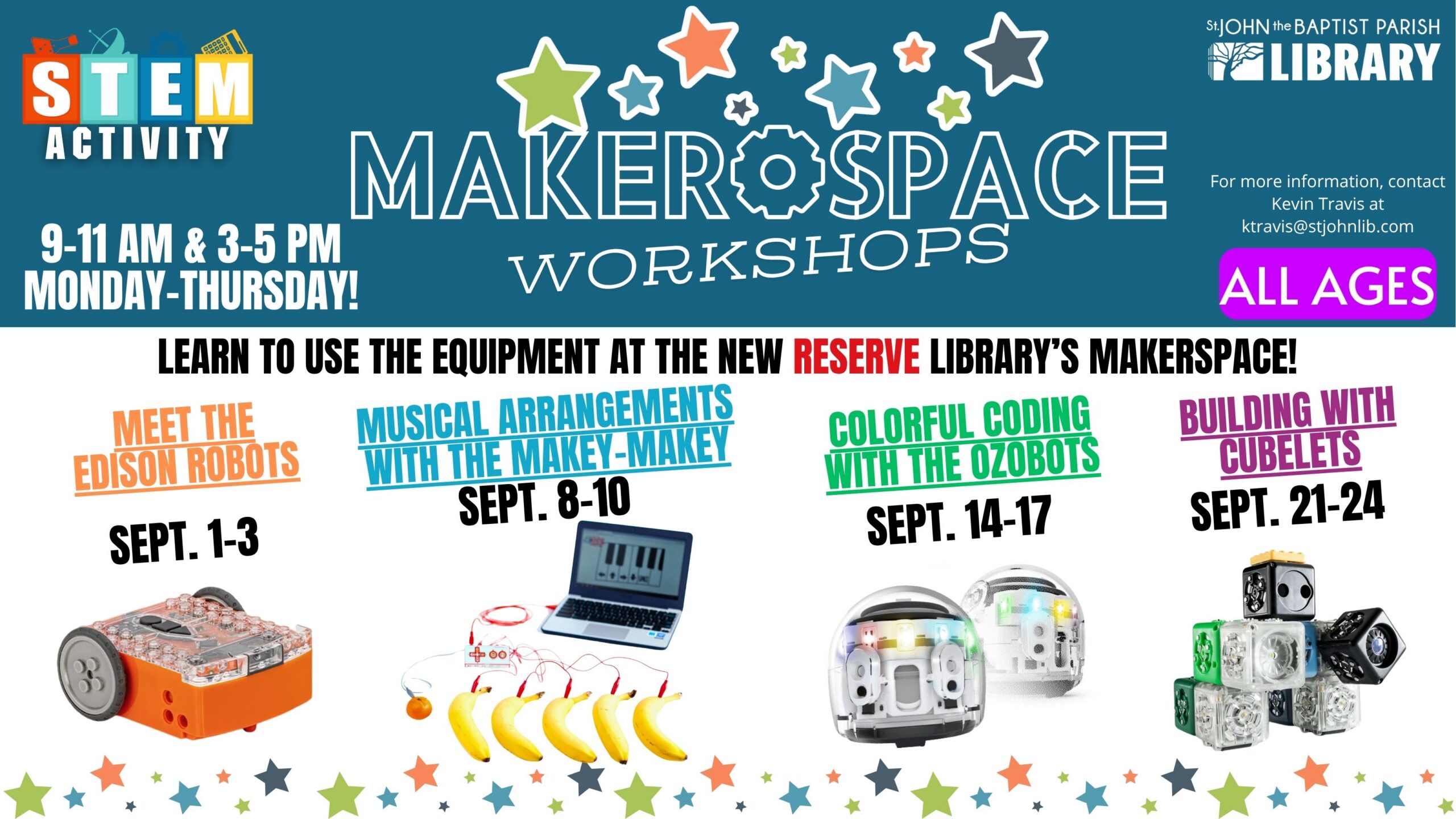
The state-of-the-art MakerSpace at the Leroy D. Williams Memorial Library in Reserve is packed with low- and high-tech equipment available for use in library programs and creative uses by individuals and groups. Weekly workshops are typically held Monday through Thursday from 9-11 a.m. and from 3-5 p.m., focusing on a specific piece of equipment. Community members who attend the workshops earn a badge of completion so they may continue to utilize the MakerSpace for their own creative endeavors.
While there is no charge for activities that are part of library programs, including the weekly workshops, there will be a minimal charge for materials and supplies for individuals and groups utilizing the technology in the MakerSpace.
This month’s workshops introduce patrons of all ages to the basics of coding.
September 1-3: Meet the Edison Robots
Edison bots are programmable robots designed for STEM education. They feature built-in sensors, lights, and sounds, and are compatible with LEGO bricks. We will learn how to operate the robots using a basic introduction to coding and the EdScratch programming software.
September 8-10: Musical Arrangements with the Makey-Makey
The Makey Makey is an easy-to-use invention kit that lets you turn everyday objects into touchpads and keyboard keys for your computer. We will learn how to make different musical arrangements with a laptop, paper clips, cables, and gummy candies as keys.
September 14-17: Colorful Coding with the Ozobots
Ozobots are tiny, pocket-sized smart robots designed to teach kids coding and computer science through hands-on play. They use optical and color sensors on their underside to read lines and colors. Using paper and color-coded markers, we will learn how to code and make paths to see the bots light up and perform commands.
September 21-24: Building with Cubelets
Cubelets are small, magnetic, modular robot blocks that snap together to build working robots without traditional coding. They are divided into three functional categories: Sense (inputs), Think (processors), and Act (outputs). We will learn how each cube functions individually and when combined to make one large, maneuverable robot.